Your PMS Sells a Booking Engine; Your Hostel Guest Demands a WhatsApp Chat

Gustavo Marval
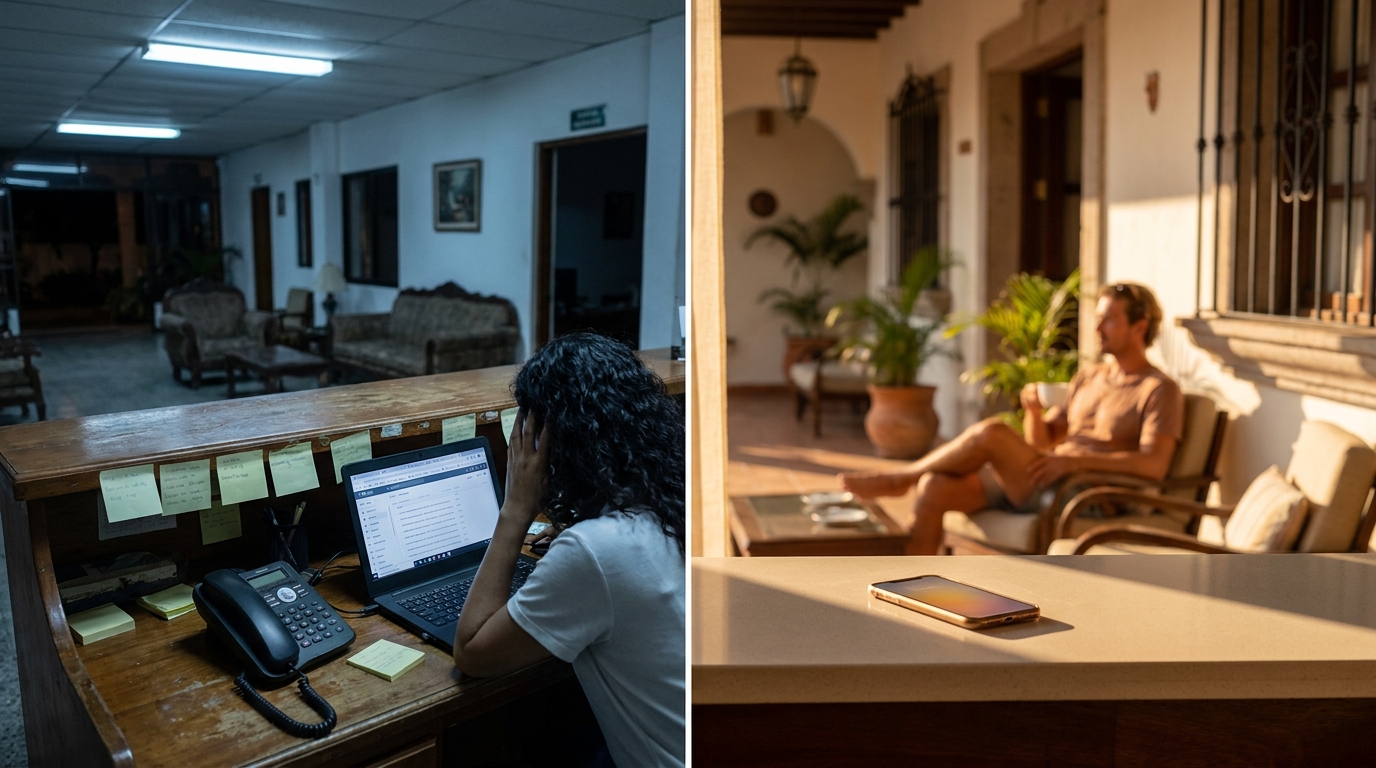
It's 1:30 AM in Mendoza, Argentina. A WhatsApp notification chimes. A Brazilian tourist is asking if you have a bed available for tonight. You're asleep. At 7 AM, you reply with a cheerful "Yes, of course!" and the link to your PMS's booking engine.
Silence.
At 7:15 AM, you get a notification from Hostelworld. The same name. They've just booked, paying a 15% commission you could have saved.
The problem isn't that the guest prefers the OTA. The problem is that between their question and your link, you created insurmountable friction. Your direct channel isn't your website. It's the chat you already had open.
We believe the solution for capturing more direct bookings is a prettier or faster booking engine on our website. The reality is that hostel guests don't want to leave the conversation. Every click away from WhatsApp is an invitation to give up and open Booking.com, where payment is instant and hassle-free.
The real failure isn't in the tool, but in its location. You're installing an excellent front door, but in the backyard. 90% of your potential guests are already knocking on the actual front door: WhatsApp.
The Cost of the 'Extra Tab': Measure Your Payment Funnel Abandonment
When you send a PMS link to a guest on WhatsApp, you kick off an obstacle course. The guest must: open the browser, re-enter dates, fill out a form, and finally, face the payment options. In many parts of Latin America, this means a "bank transfer."
The process gets longer: they must minimize WhatsApp, open their banking app, copy your account number, paste it, make the transfer, take a screenshot, and return to WhatsApp to send you the proof. That's at least eight steps. By the third step, their patience has run out and they've already opened an OTA app.
Your web booking engine isn't designed for mobile immediacy. It's a desktop solution forced into a conversational environment. The key isn't to optimize the payment page, but to remove it from the browser entirely and bring it into the chat. This is the first step to building a true Booking.com alternative with your direct channel.
Inventory by Bed, Not by Room: The Logic Your PMS Ignores on WhatsApp
A standard booking engine thinks in rooms. Your hostel thinks in beds. This fundamental difference breaks the sales logic for 50% of the inquiries you receive. "Do you have two beds in the 6-person dorm?" or "We're a group of 4, can we stay together?"
Your PMS doesn't understand this fragmented logic. It forces you to check inventory manually and reply. That delay is fatal. A generic `hotel chatbot` doesn't get it either; it's programmed to sell a "Standard Double Room," not a "lower bunk, mixed dorm."
A system designed for a hostel's DNA knows that a bed is the minimum sales unit and can manage complex inventory in real time. It understands that a solo traveler's question has a security intent, while a group's question prioritizes staying together. A true hostel-specific chatbot responds to intent, not just availability.
The Conversation as an Asset: WhatsApp Gives You a Guest, the PMS a Transaction
Every booking that comes through your PMS engine is a successful transaction. It gives you dates, a name, and money. But every WhatsApp conversation, even those that don't convert, is a strategic asset. It gives you raw demand data: what are they asking? What are their objections? What time do they inquire?
This stream of information is gold. An `AI hotel chatbot` not only answers but also categorizes and analyzes these interactions, revealing patterns your PMS will never see. Maybe you discover that 20% of non-bookers ask about lockers—a sign to improve your photos or descriptions. `Hotel WhatsApp direct bookings` are a source of market intelligence.
Tools like HotelChatBook handle the full booking flow inside WhatsApp—availability, price confirmation, and payment—without routing the guest to a web form. This turns the chat into a measurable and optimizable sales channel, not just a support center.
From 15 Minutes per Booking to Instant Confirmation
Imagine a 50-bed hostel in Mendoza. Before, the front desk team spent an average of 15 minutes on each manual WhatsApp booking. This included checking availability in the PMS, sending bank transfer details, waiting for the receipt, and finally entering the booking. The closing rate for a qualified inquiry was 40%. Many were lost overnight.
By implementing a native `conversational booking engine` in WhatsApp, the time per booking dropped to zero. The bot qualifies, quotes, and most importantly, processes the payment with a local payment link (like Mercado Pago) inside the chat itself. The conversion rate jumped to 75% because the payment friction disappeared. Overnight bookings, previously lost, are now captured automatically, generating `commission-free direct bookings` while the staff sleeps.
Your Next Steps for This Week
You don't need to change your entire system tomorrow. Start by measuring the friction.
- Audit your chats: Review the last 20 WhatsApp conversations that didn't end in a booking. At what point did the conversation die? Was it after you sent the payment link?
- Map the payment process: Write down the exact steps a guest must follow to pay you via bank transfer. Be honest. How many clicks and app switches are involved?
- Evaluate the native payment flow: Explore how `WhatsApp Business for hotels` can integrate with your local payment providers directly within the chat.
If you want to see how an automated flow handles availability, pricing, and payments with local methods without ever leaving the conversation, schedule a call with HotelChatBook for a diagnosis of your direct channel.