Where the Smart Hotelier mindset is built
This isn't a blog. It's a foundational knowledge base.
We don't write here to fill keywords, chase traffic, or publish for the sake of publishing. We write to define how hospitality should be thought about today.
Why this Knowledge Hub exists
Hospitality is going through a silent change:
But most content out there repeats old formulas, talks about tools, and avoids questioning the model.
Here we do the opposite.
What you'll find here
Clear ideas about:
All from real experience. No hype. No fads.
Knowledge designed for better decisions
This Knowledge Hub is designed for:
Who want to understand before buying and think before automating.
Foundational articles
The essential readings to understand how modern hospitality should work.

How to Implement Artificial Intelligence in Your Hotel, Step by Step
Learn how to implement AI in your hotel: where it adds the most value, how to choose a tool, prepare your data, train your team and measure ROI. Includes how HotelChatBook simplifies the process.

Chatbot for Glamping: How to Sell Experiences and Receive Bookings via WhatsApp
Discover how a WhatsApp chatbot can revolutionize glamping sales. Learn to overcome common challenges, automate direct bookings, and captivate your guests with a conversational, visual, and commission-free booking process.
WhatsApp Business API for Hotels: A Practical Guide to Start Selling from Chat
Discover how the WhatsApp Business API goes beyond the app, enabling hotels to automate, personalize, and manage conversations at scale to enhance customer experience and maximize direct sales. This guide explores its differences, benefits, and implementation steps.
Conversational Booking Engine: What It Is and Why Your Hotel Should Have One
Discover what a conversational booking engine is, how it differs from traditional systems, and why its implementation is crucial for hotels aiming to maximize direct sales and enhance guest interaction in the digital age.
AI First in Hospitality (Well Applied)
Adopting Artificial Intelligence in hospitality goes beyond a simple chatbot. This article explores what it means to be "AI First," highlighting the importance of designing intelligent systems from the ground up to ensure consistent responses, efficient operations, and a superior guest experience, especially crucial for smaller hotels.
What is a Cognitive Hotel Brain?
Modern hospitality faces the paradox of having many tools but lacking a unified system that can truly think and act. This article explores the concept of the Cognitive Hotel Brain, an AI-first architecture that integrates key processes to transform hotel operations and guest experience, bringing efficiency and coherence to a new level.
Conversational Booking Engine vs. Traditional Booking Engine
Explore the fundamental differences between conversational and traditional booking engines. This article delves into how a shift in mindset, beyond mere technology, redefines the guest experience and optimizes direct sales in the hospitality industry. Understand why the conversational model is crucial for the future of hotel bookings.
Why Hotels Lose Bookings on WhatsApp
WhatsApp has become the decisive channel for hotel bookings, yet many hotels lose valuable opportunities due to inefficient management. This article explores how a lack of immediacy, consistency, and structure in WhatsApp communication transforms this powerful engine into a sieve for direct revenue. Discover why "I'll respond later" is the costliest mistake and how a conversational system can protect and boost your bookings.
Complete Guide: How to Automate Your Hotel Bookings via WhatsApp in 2026
Discover how hotels can transition from manual WhatsApp inquiry management to automating the entire booking process. This detailed guide covers essential tools, key steps, and common pitfalls to avoid, optimizing your communication and sales strategy for 2026.
Conversation is the New Booking Engine
Explore how the traditional click-based booking model has been overtaken by direct conversation in the hotel sector. Discover why modern guests prefer to interact via chat and how hotels can leverage this trend to maximize their direct bookings and build lasting relationships.
Hotel AI: How to Automate Revenue Management and Drive Direct Bookings Without OTA Dependency
Explore how Hotel AI is revolutionizing revenue management, enabling properties to fine-tune pricing in real-time, reduce reliance on OTAs, and maximize profitability through a robust direct booking channel.
Hotel AI: How PMS Companies Can Offer Booking Automation as a Service Without Building It From Scratch
Discover how PMS companies can provide advanced booking automation and 24/7 communication solutions to their hotel clients, without internal development, by integrating a dedicated AI layer into their existing hospitality tech stack.
Hotel AI: Why Your Hospitality Marketing Campaigns Aren't Converting and How Automation Closes the Gap
Learn why hotel marketing campaigns often fail at the final conversion stage and how an AI sales agent can automate social media response to secure direct bookings, maximizing your campaign ROI.

Hotel Chatbot: Automation and Scalability Strategy for Chains
Explore how a hotel chatbot can be a pivotal strategy for hotel chains aiming to standardize booking automation and guest service, enhancing scalability and gross operating profit.
Hotel chatbot: more than just a simple chat assistant
Learn the difference between a generic chatbot and an AI sales agent designed for independent hotels. Automate bookings and guest service 24/7.
WhatsApp chatbot for hotels: turn messages into bookings
Discover how a **WhatsApp chatbot for hotels** can transform your conversations into direct bookings. Learn the key steps for implementation.
Direct hotel bookings: reduce OTA commissions strategically
Learn how to increase **direct hotel bookings** and minimize OTA dependence. Calculate the true impact of commissions on your profitability.
Conversational booking engine: saying goodbye to forms?
Analyze the key differences between a **conversational booking engine** and traditional forms. Discover which generates more conversions for your hotel.
Hotel Google Calendar booking: avoid overbooking without a PMS
Discover how independent hoteliers can efficiently manage bookings using Google Calendar and iCal to prevent overbooking without relying on a complex PMS.
Multilingual hotel chatbot: serve the world from WhatsApp
Learn how a multilingual chatbot can transform guest service at your hotel, responding in English, Portuguese, or Spanish directly from WhatsApp.
Hotel WhatsApp message templates: bookings and upsell
Discover ready-to-use WhatsApp templates that will help you confirm bookings, prevent cancellations, and generate additional sales at your hotel.
Chatbot for Hostels: Automate Bookings and 24/7 Check-in
Discover how a chatbot for hostels can transform booking management, check-in processes, and guest communication, optimizing daily operations and enhancing the overall guest experience at your property. Explore its key benefits.
Hotel Chatbot Pricing: Investment vs. Real ROI
Explore common hotel chatbot pricing models, compare real-world ranges, and calculate the return on investment (ROI) compared to high OTA commissions. Optimize your budget and boost profitability.
How to Stop Relying on Booking.com: A Guide for Hotels Seeking Direct WhatsApp Bookings
Discover a practical and effective strategy for small and and medium-sized hotels aiming to reduce their reliance on OTAs like Booking.com. Learn how to boost direct bookings through WhatsApp, minimize commissions, and strengthen customer relationships.
AI for Small Hotels: How to Get More Direct Bookings Without Being Tied to WhatsApp All Day
AI is no longer exclusive to large chains. Learn how to leverage it for your small hotel to automate direct bookings, provide 24/7 guest service, and free yourself from constant phone duty.
AI for Hotel Chains: Standardizing Guest Experience and Reducing OTA Commissions Across All Properties
Discover how AI can be the cornerstone for unifying service quality and maximizing direct bookings in hotel groups, positively impacting the global margin.
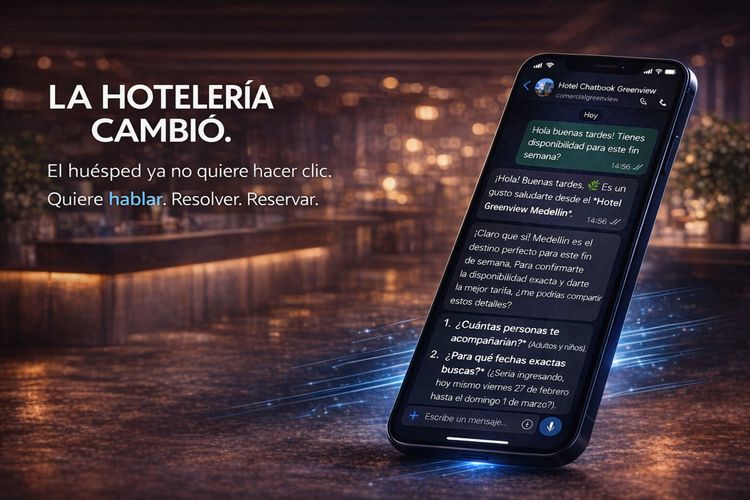
Chatbook for Small Hotels: Try the Demo and Automate WhatsApp Bookings
A small hotel doesn't have to miss out on bookings. Learn how a chatbot can automate your direct channel via WhatsApp in just 10 minutes, eliminating commissions and capturing leads 24/7.
ChatBook Demo: Automate Guest Service Without Losing the Human Touch
Explore how an AI assistant, trained with your hotel's digital footprint, can manage repetitive inquiries 24/7, freeing your team for high-value interactions while maintaining human warmth.
ChatBook Demo for Revenue Managers: AI Direct Booking Channel with PMS Integration
Discover how ChatBook can transform your direct sales channel with AI, integrating with your PMS to offer real-time rates and eliminate commissions, maximizing your property's ROI.
ChatBook Demo for Agencies: Turn Your Campaign Leads into Actual Bookings
Discover how an AI assistant bridges the gap between lead generation and booking conversion. A demo for marketing agencies looking to deliver tangible results to hotels.
ChatBook Demo for Hotel Chains: Multi-Property AI Booking Engine
Discover how ChatBook centralizes AI booking management for multiple properties, integrating with PMS to optimize revenue, ensure brand consistency, and reduce OTA costs.
This knowledge isn't neutral
And it doesn't pretend to be.
It has a clear stance:
If this resonates with you, this hub is for you.
Knowledge is the beginning
Execution comes after.
Reading doesn't sell rooms. Thinking better does.
That's why hotelchatbook exists: to execute these principles in daily operations.
See hotelchatbook in action